
To a beginning reader, the act of reading can be a momentous task. Incorrectly taught, reading becomes a burdensome and arduous chore. Taught correctly, reading motivates the child to want to learn more.
In recent years, there has been much debate about how children should be taught to read. While the use of phonics has generally been advocated for this, the actual approach on how it should be used has been contentious. However, recent research carried out in the UK and elsewhere has shown that a method called systematic synthetic phonics (as opposed to other phonics approaches, such as analytical phonics) leads to better reading and spelling attainment among children.
Phonics Fun is our exciting learn-to-read programme especially designed for the beginning reader. Built on the principles of systematic synthetic phonics, Phonics Fun takes advantage of interactive multimedia to make learning to read even more fun and stimulating.
Children are taught three main things:
Children also learn to recognize specific “tricky” words – words that are not spelt or pronounced according to the phonic “rules” that they are taught.
There are also fun and exciting activities designed to reinforce what is taught in the lessons.
Each topic comprises 4 sections, viz.,
1. Lesson + Word Smart 2. Let's Practise 3. Let's Say It
1a. LessonCovers 3 crucial skills:
Covers lateral expansion of literacy development:
Children listen to two tongue twisters, two rhymes, and a song. The tongue twisters, rhymes and song have sounds that the learner has just learnt. Words are highlighted in red as they are read out.
2. Let’s PractiseCovers two practice exercises that reinforce learning. Covers the three crucial skills in phonics, i.e. sound-letter relationship, blending and segmenting.
3. Let’s Say ItCovers sound recognition:
Six words are introduced for each phoneme taught. Children can tap on the words to listen to their pronunciation.
To get the best results, we suggest that the child learns in the order shown below.
Step 1: Learn the sounds of letters.This is covered in the section, 'Sounds of Letters'. Here, the child learns the phonemes (sounds) of the English language, as well as the graphemes (letters) that correspond to those sounds.
Step 2: Learn how to blend sounds and segment words.This is the central part of learning to read, and is taught in the 'Lesson' section. When the child blends sounds to form a word, the child is, in effect, reading. When the child segments a word into its constituent sounds, the child is actually spelling. Tricky words - words that do not conform to phonics rules - are also taught in this section.
Step 3: Relate what is learnt to stories, rhymes and songsMaintain the child's interest with some vocal activities through 'Word Smart'. By engaging the child in stories, rhymes and songs that have relevance to what is taught, we accomplish two things: one, learning is reinforced; two, the child learns to appreciate language arts.
Step 4: Practise the skills learntPut into practice what has been taught by doing the exercises in 'Let's Practise'. Two practice exercises are provided per topic to strengthen the 3 basic phonics skills:
Apply phonics skills to read new words that have the phonemes already learnt, by following 'Let's Say It'.
Phonics is simply the connection between letter symbols and sounds. Using phonics, children are taught the relationships between letters and sounds. Children then use these relationships to read, write and speak words.
What is phonetics?In linguistics, it is the study of speech sounds in all their aspects: how these sounds are produced by the speech organs (articulatory phonetics); how they are transmitted and how those transmissions can be analyzed (acoustic phonetics); how they are received by the ear and understood (auditory phonetics).
What is the difference between Phonetics and Phonics?A lot of people confuse phonetics with phonics. This short write-up should help clear the confusion. Phonetics is the branch of linguistics which studies the use of sound in human language. It involves the study of the physical nature of speech sounds and speech production: how sounds are produced by the human body, what they are like as sound waves, and how the human ear processes speech.
Phonics is a method for teaching reading. The phonics method trains learners to use the relationship between sounds and letters in the English spelling system to help them decode words. To decode a word is to match the letters in the word to sounds in the language, thereby recognizing which word the letters spell. Decoding is nothing more than reading.
One reason why people confuse phonetics with phonics is that the word “phonetic” (or any of its derivatives) is sometimes used in ordinary language to mean something that is different from the linguistics sense. In ordinary language, for example, we may speak of the spelling system of Malay as being more phonetic than that of English. Or that 84% of English words are phonetically proven. In the two examples, we are not talking about the branch of linguistics; rather, we are talking about the regularity of the spelling system (i.e. how predictable the relationship between sounds and letters is).
Another cause of confusion is the use of the IPA (International Phonetic Alphabet) in both phonetics and phonics.
It must be stressed, though, that children learning to read do NOT learn the IPA. The IPA is for the teacher to know, not the children. The IPA representation is a pronunciation reference for the teacher. In teaching reading using phonics, the teacher needs to know how phonemes sound and how words are pronounced. Using the IPA helps the teacher to sound out phonemes and words correctly. An example of the IPA chart (used for sounds of the English language) is shown below.
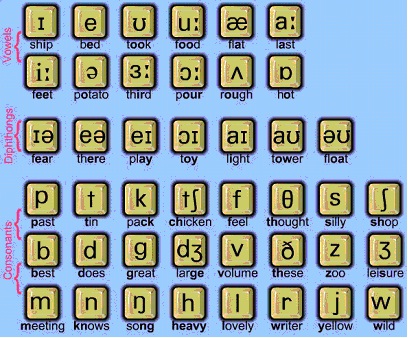
The British International Phonetic Alphabet chart
‘Blending’ means ‘joining together’. Blending letter sounds means joining the sounds of letters together. We blend sounds to make a word. Blending is an essential skill in learning to read. Click here to link to a video that explains blending using Phonics Fun.
What is segmenting?‘Segmenting’ means ‘breaking’ or ‘separating’. When we segment a word, we break the word up into its individual sounds. Click here to link to a video that explains segmenting using Phonics Fun.
What is the International Phonetic Alphabet?The International Phonetic Alphabet (IPA) is an alphabetic system of phonetic notation based primarily on the Latin alphabet. It was devised by the International Phonetic Association as a standardized representation of the sounds of oral language. Though they are primarily designed for representing speech sounds, the IPA symbols are naturally also widely used for representing the phonemes of particular languages.
What are the commonly used phonics approaches in teaching reading?There are several approaches that use phonics as the basis of teaching reading: synthetic phonics, analytic phonics, analogy phonics, and embedded phonics.
Synthetic phonics
Analytic phonics
Analogy phonics
Embedded phonics
No. Phonics Fun teaches the 44 sounds used in English, and the relationship between these sounds and the letters of the alphabet. Learning the sounds and their relationship to letters allows the beginning reader to read and spell regular words, that is, words that follow standard phonics “rules”. In addition, the beginning reader also learns to read some sight words: words that occur often (high frequency words like ‘a’, ‘I’, ‘the’), and words that do not follow phonics roles (irregular words like ‘queue’, ‘plague’).
Application of phonics rules and recognizing sight words are two of the strategies used in Phonics Fun to teach reading. Using these strategies, the learner will acquire, by the end of the programme, sufficient reading skills to read grade-appropriate text.
Beyond this, however, the learner needs to be taught other reading strategies in order to decode much of the remaining English words that are not phonetically regular. These additional reading strategies are not taught in Phonics Fun, but in another programme, Beyond Phonics, which is not available online as yet.
Why doesn’t Phonics Fun teach letters in alphabetical order?Phonics Fun uses an approach that teaches children to read words in the shortest time possible. This is not done by teaching letters in alphabetical order. Rather, the letters are systematically grouped in an arrangement that allows the optimal number of words to be formed. Thus, ‘s’, ‘a’, ‘t’ and ‘p’, are taught first, from which the child can learn to read, for example, the words ‘as’, ‘sat’ and ‘tap’. The ability to read a few words from the very first lesson motivates the child to want to learn further.
In each lesson, only words that can be decoded at the level reached by the learner are presented for the learner to read. Words with sounds/letters that have not been taught are not put in the reading list. For example, the sound /k/ and the letter ‘k’ are taught in Topic 3. In that lesson, the word ‘kit’, which is formed from /k/, /ɪ/ and /t/, is introduced. The child has already learned /t/ in Topic 1, and /ɪ/ in Topic 2. The word ‘kit’ is therefore decodable at this level. This strategy enables the child to read new words without difficulty.
Should reading be taught before spelling?In Phonics Fun, children are taught to both read and spell right from the start.
Phonics Fun is based on the teaching guidelines drawn up by the U.K.’s Department for Education. The programme covers the 44 phonemes, or sounds, in the English language, and their associated graphemes, or written representations.
The contents also meet the KSSR syllabus requirements drawn up by the Ministry of Education, Malaysia.
I am not trained in systematic synthetic phonics. How can I teach my students to read using a system I know little about?Phonics Fun helps teachers to teach reading in two ways:
1. By providing teachers with a convenient and simple way to learn and master phonics skills.2. By providing teachers with a model for teaching reading using phonics.
Phonics Fun teaches the fundamentals of phonics and reading:
In effect, Phonics Fun provides a “teaching template” that you can easily use and follow. This “template”:
Phonics Fun helps teachers in two ways:
1. Tools: Phonics Fun uses technology to teach reading in innovative and creative ways. It allows students to take charge of their own learning through direct exploration, expression, and experience, shifting the student’s role from ‘‘being taught’’ to ‘‘learning’’, and the teacher’s role from ‘‘expert’’ to ‘‘collaborator’’ or ‘‘guide’’.
2. Time: Phonics Fun allows for self-learning by students, thereby freeing some of the teachers’ time. If there is a shortage of time in class, students can make up for it by extending the lessons through informal learning at home.
Will Phonics Fun replace the teacher where teaching reading is concerned?No. Although Phonics Fun allows for self-learning by students, it is not intended to replace the teacher in the classroom. Instead, it is designed to complement the teacher’s work by providing her with an innovative and engaging resource.
Phonics Fun helps to change teachers’ pedagogic practices from a teacher-centred model to a student-centred one. Teachers can play Phonics Fun lessons in class and ask students to answer the pre-designed interactive questions. There are three interactive practices for each lesson and most of the questions are randomised.
Teachers can also use Word Smart (a section in Phonics Fun) to develop wider reading skills in the students. Word Smart helps in literacy development through the use of sentences, songs, rhymes or stories that reinforce the sounds that students have learnt in a lesson. Words are highlighted in red as they are read out.
Is Phonics Fun easy to use in the classroom?Yes. There are two ways to run Phonics Fun in the classroom: play the CD-ROM version, or run the online (Internet) version using a broadband connection.
To play the CD-ROM version, you need to preinstall the programme first (a one-time installation) and run the CD-ROM in the CD drive. Since this does not require an Internet connection, you will have a disruption-free lesson. Click here to know more about the purchase of CD-ROM.
The online version, on the other hand, saves you from having to install the programme on your computer, and can be run wherever there is a broadband connection. Click here to know more about subscribing to the online programme.
How will this programme engage students' attention?Phonics Fun teaches children how to read using a scientifically-based approach that has been proven to be effective. For example, lessons are taught from simple to complex, are fun-filled to capture attention, and have practices that are repeated using different approaches to reinforce learning.
Phonics Fun also applies what is known from neuroscience about how the brain learns and combines that knowledge with technology, psychology, educational content and pedagogy to design lessons that match the children's mental and physical development. Our brain learns best when it is taught in a systematic and structured way through an interactive and multisensory approach, and superior learning takes place when learning activities are enjoyable.
In short, Phonics Fun focuses on how children learn, so that they can learn in the most effective way.
How can teachers set classwork and homework with Phonics Fun?We suggest that teachers pre-assign classwork before a lesson (provided students also have access to the programme). When class begins, teachers can start their lesson with students having some understanding about the lesson being taught. Click Level 1 or Level 2 to download the relevant content of Phonics Fun.
What is the teaching strategy used in Phonics Fun?Phonics Fun applies the TPACK (Technological, Pedagogical and Content Knowledge) framework in its teaching strategy. Click here to download the PDF on how we integrate TPACK in different sections in Phonics Fun.
Allows you 1 year’s access* to all the contents of the Phonics Fun through our website.
Subscription expires one year from your first login date.